
How to Improve Sentence Structure: 7 Techniques That Actually Work
Fix choppy, monotonous or confusing sentences with seven structural techniques, each with a before-and-after pair you can copy into your own editing pass.
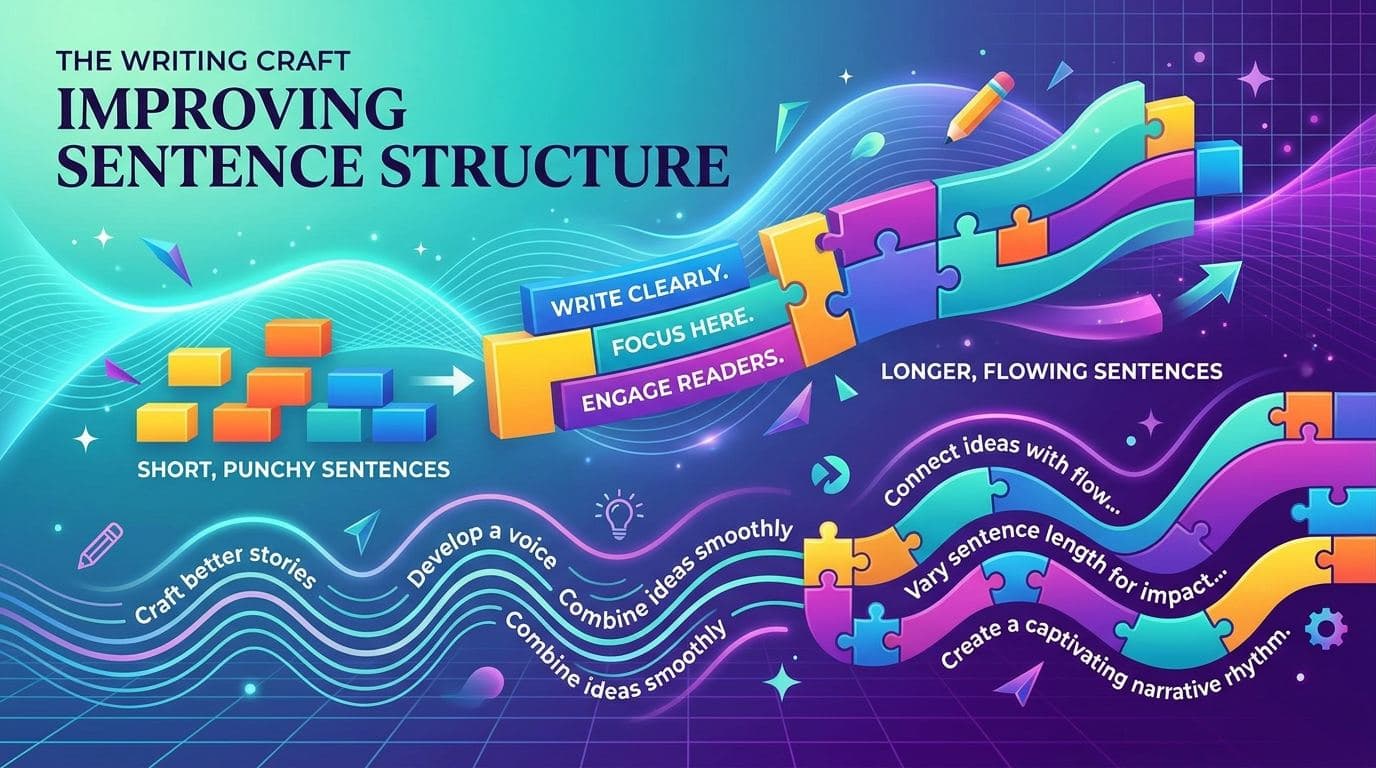
Bad sentence structure rarely announces itself. You don't notice it as bad structure; you just feel the writing is somehow off, and you lose the thread mid-sentence and have to read it again.
Sentence structure is how you arrange the parts of a sentence: its length, where it begins, and how its clauses relate. Improving it comes down to two levers. Vary your sentence lengths so that no three consecutive sentences land within three words of each other, and start at least a few sentences with something other than the subject.
Why every sentence sounds the same
Most structural problems come from one cause, which is monotony. The same move, repeated:
- Every sentence starts with "The" or "I" or "We"
- Every sentence runs to roughly the same length
- Every sentence follows the same subject-verb-object order
- Passive constructions dominate, whether or not they are warranted
Deliberate variety is the fix. Change the length, change the opening, and the rhythm follows. The seven techniques below are that instruction broken into things you can actually check for.
Technique 1: Vary sentence length
A mix of lengths creates a reading rhythm that feels natural. Short sentences add punch. Longer ones let you develop an idea, establish context and carry the reader through a more complex thought before landing on the key point.
Monotonous:
The data was collected. The data was analyzed. The results were significant. The team was pleased.
Varied:
The team collected and analyzed the data, finding results that exceeded expectations. They were pleased.
Look at how the second version moves. Four ideas compressed into two sentences, and neither feels rushed.
Technique 2: Vary sentence openings
Starting every sentence with its subject is the most common cause of monotonous prose. Six alternatives, each of which puts something else in front:
| Opening type | Example |
|---|---|
| Adverb | Surprisingly, the results exceeded all expectations. |
| Participial phrase | Having analyzed the data, the researchers published their findings. |
| Prepositional phrase | In the final phase of the study, three anomalies emerged. |
| Transition word | However, the initial results were inconclusive. |
| Conditional clause | If the data is incomplete, the analysis will be unreliable. |
| Appositive | A seasoned researcher, she spotted the error immediately. |
You don't need all six. Rotating between two or three across a page creates most of the available variety, and using all six in one paragraph reads as an exercise.
Technique 3: Use subordinate clauses
Subordinate clauses show how ideas relate. Without them every sentence carries equal logical weight, which is usually inaccurate and always flat.
| Relationship | Connector | Example |
|---|---|---|
| Causal | because, since, as | Because the deadline was tight, we simplified the process. |
| Conditional | if, unless, provided | If the data is incomplete, the analysis will fail. |
| Temporal | when, after, before | When the results arrived, the team reconvened. |
| Concessive | although, even though | Although the sample was small, the findings were significant. |
| Purpose | so that, in order to | We ran a second test so that we could verify the outcome. |
Notice that the connector does the reasoning for the reader. "Although" tells them the two halves are in tension before they have read the second half.
Technique 4: Combine short, choppy sentences
Short sentences aren't a problem in themselves. Too many in a row are, because they read as a list of unrelated facts.
Before:
The experiment failed. The team was disappointed. They tried again.
After:
When the experiment failed, the disappointed team tried again.
Three sentences became one. "When" supplies the causation the original left the reader to infer, and the emotion moves into the noun phrase instead of standing alone as a fact.
Technique 5: Split long, unwieldy sentences
Sentences over about thirty words get genuinely hard to follow, because the reader has to hold too much in memory before the sentence resolves.
Before:
The researchers, who had been working on the project for three years and had overcome numerous setbacks along the way, finally published their findings in a peer-reviewed journal.
After:
The researchers had worked on the project for three years, overcoming numerous setbacks. They finally published their findings in a peer-reviewed journal.
Same information, two sentences, much easier to absorb.
Natural split points to look for:
- Semicolons separating independent clauses
- "And," "but" or "while" connecting two full thoughts
- Relative clauses that could stand alone
- Appositives, meaning phrases set off by commas that rename or describe
Technique 6: Fix dangling modifiers
A dangling modifier is an opening phrase that doesn't attach to the right subject. The results are often absurd and always confusing.
Dangling:
Running to catch the bus, the briefcase was left behind.
The briefcase was running?
Fixed:
Running to catch the bus, he left his briefcase behind.
The rule: whatever appears immediately after the opening comma must be the thing doing the action in the opening phrase. Note that the broken version is also passive, which is what let the real subject disappear in the first place. Our guide to active and passive voice covers why the passive so often hides the actor.
Technique 7: Keep subject and verb close together
Long gaps between a subject and its verb force readers to hold the subject in mind while processing everything in between.
Difficult:
The data, which had been collected over three years by a team of researchers from five different institutions using four separate methodologies, showed significant trends.
Better:
The data showed significant trends. It had been collected over three years by researchers from five institutions using four methodologies.
The second version gives you the main point immediately, then delivers the context. That ordering is also what makes the sentence shorter, which is why structural editing and cutting wordiness tend to happen in the same pass.
Quick structural checklist
Run this over a draft before anyone else sees it:
- Sentence lengths vary, with a mix of short, medium and long
- No more than two or three consecutive sentences start with the same word
- No dangling modifiers
- Subject and verb sit within about ten words of each other in most sentences
- Sentences over thirty words have been split or clarified
- Passive voice is used on purpose, not by accident
- At least a few sentences open with something other than the subject
Frequently asked questions
How do I know when a sentence is "too long"?
A practical rule: if you can't read it aloud without taking a breath, it's too long. Another: if you had to read it twice to understand it, it probably needs breaking up. Sentences over thirty-five words almost always benefit from splitting.
Is varying sentence structure worth it for short-form content like emails?
Yes, arguably more so. Emails get read quickly and in distracting places. Structural variety keeps the reader with you and makes the key points easier to find on a skim.
How many sentences should have varied openings?
There's no precise rule. If three or more consecutive sentences start the same way, vary one of them.
Does sentence structure affect SEO?
Not in any way Google has published. Sentence length and passive-voice ratio are not documented ranking factors. Clear structure helps because people finish prose they can follow, which is a good enough reason on its own.
Can sentence structure be automated?
Partially. The Sentence Rewriter flags repeated openings, passive constructions and overly long sentences, and the Readability Checker will show you your average sentence length. Deciding how to restructure still benefits from a person reading the result.
What's the single most impactful structural change a writer can make?
Varying sentence length. It's the simplest change and the one that most immediately affects how natural the writing feels.
Where to start
Pick the longest paragraph in your draft and count the words in each sentence. If the numbers cluster, you have found your problem, and techniques 1 and 4 will fix most of it in a single pass. The trade-off to expect is that deliberate variance feels artificial while you're doing it and invisible once it's done.