
Active Voice vs Passive Voice: When to Use Each (With Examples & Tables)
Understand the real difference between active and passive voice in English writing. Packed with before/after examples, comparison tables, and a full FAQ section.
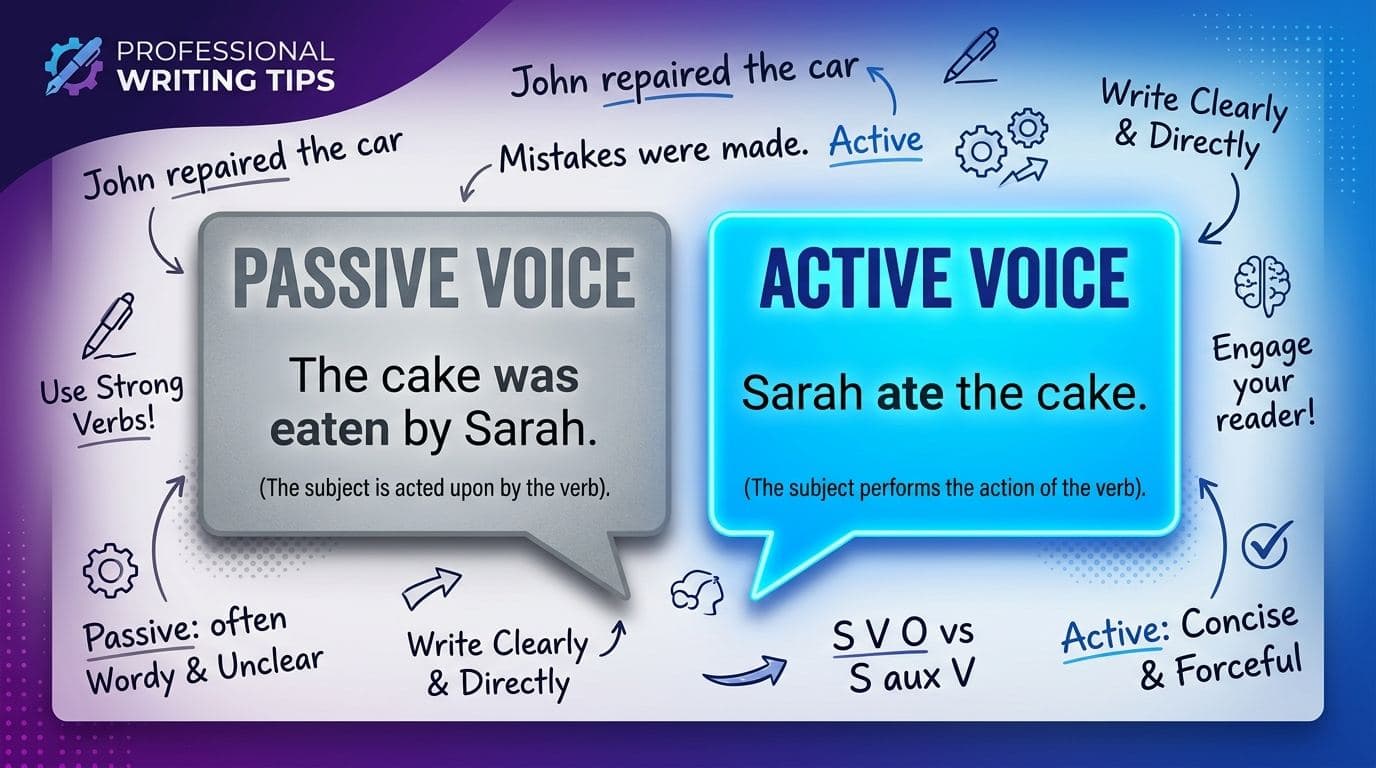
Passive voice is not a grammar error. It is a choice, and most first drafts make that choice by accident.
In active voice the subject performs the action: the marketing team launched the campaign. In passive voice the subject receives the action: the campaign was launched by the marketing team. To find passive voice, look for a form of "to be" followed by a past participle, then ask who did it. If nobody is named, rewrite.
What is active voice?
In an active-voice sentence, the subject does the action.
The marketing team launched the campaign.
Subject (team) → verb (launched) → object (campaign). That order is the backbone of clear writing, because the reader learns who is responsible before learning what happened to whom. It also tends to be shorter, since there is no trailing "by" phrase to carry. Most readers process it without noticing they are processing anything, which is the point.
Active voice usually reads as more direct and more confident. It is easier to scan, because the two words a skimming reader needs sit at the front of the sentence.
What is passive voice?
In a passive-voice sentence, the subject receives the action instead of performing it.
The campaign was launched by the marketing team.
Object (campaign) → passive verb (was launched) → agent (by the team). Sometimes the agent disappears entirely:
The campaign was launched.
Now nobody knows who did anything. That is where passive voice starts causing real problems, and it is also why it shows up so often in writing that would rather not name a responsible party.
How to spot passive voice fast
Three signs, in order of reliability:
- A form of "to be" (is, are, was, were, been, being) followed by a past participle
- A "by ___" phrase after the verb
- A sentence where you have to ask "by whom?" before the meaning lands
Common passive constructions include "mistakes were made," "the report was submitted," "it has been determined that," and "the process was approved." Every one of them hides the actor. Notice that none of them is ungrammatical; they are simply incomplete as information. If your draft is full of them, the sentence rewriter will surface the pattern faster than reading line by line will.
Side-by-side comparison
| Passive voice | Active voice | Words saved |
|---|---|---|
| The cake was eaten by the children. | The children ate the cake. | 3 fewer words |
| The policy was announced by the manager. | The manager announced the policy. | 3 fewer words |
| Mistakes were made by the team. | The team made mistakes. | 2 fewer words |
| The research was conducted by scientists. | Scientists conducted the research. | 3 fewer words |
| The project has been approved by the board. | The board approved the project. | 4 fewer words |
| The app was downloaded by 10,000 users. | 10,000 users downloaded the app. | 3 fewer words |
Two or three words per sentence looks trivial. Across a 1,500-word article with fifty passive constructions in it, the same edit is the difference between a piece that moves and one that drags.
When active voice is the better choice
Reach for active voice when the reader needs to know exactly who is responsible. Business email, contracts, incident reports and news writing all work better when actions are attributed, because the attribution is usually the information. "The CEO approved the deal" says something; "the deal was approved" merely records that a thing happened.
Marketing copy has a second reason. Active sentences carry momentum, and a call to action written in passive voice asks the reader to do something without ever addressing them.
Web writing has a third. Online readers scan rather than read, and active voice puts who-did-what at the front of the sentence where a scanning eye actually lands.
When passive voice is genuinely the right call
Passive voice has a bad reputation it only partly deserves. These are the cases where it serves the reader:
| Situation | Example |
|---|---|
| Scientific and academic writing | "The samples were heated to 100°C for 30 minutes." |
| The actor is unknown | "The data was corrupted overnight." |
| The actor is irrelevant | "The law was passed in 1988." |
| Describing an automated process | "Applications are reviewed within 5 business days." |
| Shifting focus to the result | "The award was given to three deserving students." |
The distinction that matters is intent. Are you using passive voice to serve the reader, or because it was the easier sentence to write? The first is craft. The second is a habit, and habits are what editing is for.
What this does to readability
Passive constructions add words without adding information, and they push the grammatical subject away from the start of the sentence. Both effects make a sentence take longer to parse. Readability formulas register the extra words directly, since sentence length is one of their two inputs. If you want to see the effect on your own draft rather than take it on faith, run the before and after through the readability checker and compare.
Mechanical conversion is not the goal, though. Rewriting every passive sentence to active produces a different problem: a page of sentences that all open the same way and all run the same length. Three consecutive short active sentences feel choppy. One longer passive sentence, placed deliberately, breaks the pattern. Our guide to improving sentence structure covers how to build that variety on purpose.
Passive voice also travels with a second habit. Sentences that bury the actor tend to bury the verb too, turning it into an abstract noun: "the implementation of the solution was achieved." Fixing one usually exposes the other, and fixing nominalizations is the companion edit to this one.
A quick self-check before you publish
- Searched the draft for "was," "were," "been" and "being"
- Asked of each hit whether the passive form is doing a job
- Named the actor wherever the reader needs to know who it is
- Converted the unnecessary passives
- Left the deliberate ones alone
Frequently asked questions
Is passive voice grammatically wrong?
No. Passive voice is grammatically correct in every register of English. Overuse is the problem, not the construction. Used on purpose, it is a legitimate rhetorical choice, and some fields expect it.
Does Google penalize passive voice?
No. Google has not published passive-voice ratio as a ranking factor, and you should be skeptical of anyone who tells you otherwise. Write in active voice because it is clearer for the person reading, not because a search engine is counting.
How much passive voice is too much?
Style guides and editing tools commonly suggest reviewing a draft when more than 10 to 15 percent of its sentences are passive. Treat that as a widely repeated editorial convention rather than a measured threshold; no study establishes it as a limit. The grammar checker flags passive constructions so you can judge each one yourself.
Can I mix active and passive in the same paragraph?
Yes, and good writers do it deliberately for rhythm. The failure case is passive voice dominating a page without anyone having decided that it should.
What is the fastest way to rewrite a passive sentence?
Find the "by ___" phrase, because that names the actor. Move the actor to the front of the sentence and rebuild around a strong verb. When the actor is missing entirely, you have to supply it, and that is often the moment you discover the sentence was vague about something important. The common grammar mistakes guide covers the related errors that tend to cluster around these rewrites.
What to do first
Start with the sentences where no actor is named at all, not the ones with a "by" phrase. Those are the sentences hiding information, and they are the ones a reader has to reread. Expect a trade-off as you go: a draft edited too hard for active voice starts to sound uniform, so leave the passives that are earning their place.