
Does Google Penalize AI Content? An SEO Guide for AI-Generated Text
Google's stated position on AI-generated content, which of its spam policies actually apply, and how to edit an AI draft into a page that is useful enough to publish.
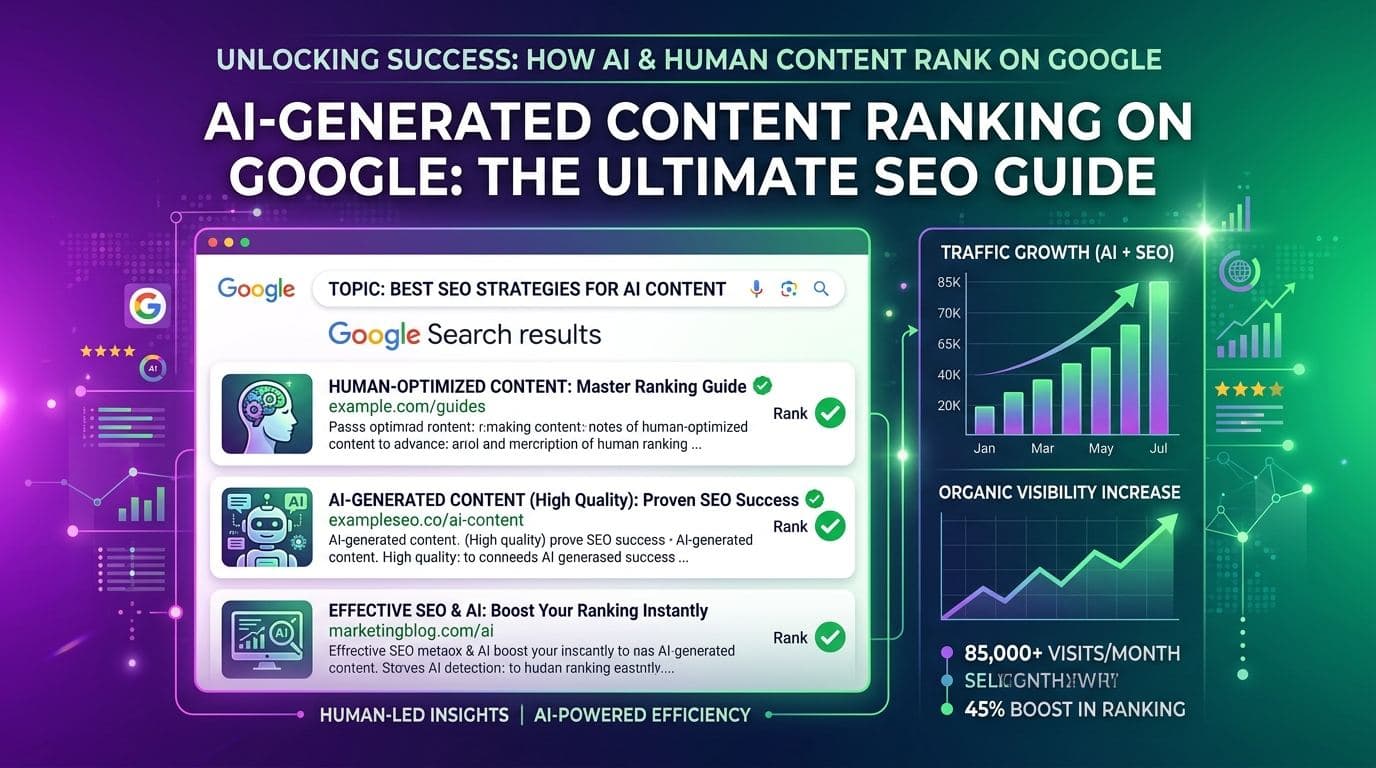
It is the question every publisher using an AI draft eventually asks, and the answer has been sitting in Google's own documentation for a while.
Google does not penalize content for being AI-generated. Its spam policies target scaled content abuse, meaning low-value pages produced in bulk to manipulate rankings, regardless of how they were written. AI content that is edited, accurate and genuinely useful is treated like any other page. Unedited bulk output is what gets demoted.
Google's stated position
Google's Search Central documentation puts it in one line:
"Our focus is on the quality of content, not the process by which it was produced."
The quality bar it describes is usually summarised as EEAT: Experience, Expertise, Authoritativeness and Trustworthiness. Experience means first-hand knowledge of the thing being written about. Expertise means specialised, accurate knowledge. Authoritativeness is credibility relative to the topic. Trustworthiness covers accuracy, safety and honesty.
A language model cannot supply the first of those four on its own, because it has no first-hand experience of anything. It can supply a competent draft of the other three, which is precisely why the editing step matters more than the generation step.
Where AI content actually runs into trouble
The official position and the practical outcome are not in conflict. There are specific situations where AI-assisted pages do badly, and none of them is about detection.
Scaled content abuse
Publishing hundreds of near-identical pages aimed at long-tail queries, with minimal human editing, is named in Google's spam policies. The signals are thin pages with no original insight, multiple pages chasing the same search intent, heavy template similarity across a site, and no internal linking into anything deeper.
Nothing the reader could not get elsewhere
If a page offers nothing beyond what a summary, an encyclopedia entry or the search results page already give, it has no reason to exist. Unique value means your research, your data, your specific case, your considered opinion. This is the hardest part to fake and the easiest part to skip.
Factual errors
Models hallucinate. They produce confident, fluent, wrong statements, and a page carrying one damages exactly the trustworthiness signal you were trying to demonstrate. Fact-check every claim, number and citation in an AI draft before it goes anywhere near publish.
Prose nobody edited
Uniform sentence length, stock transitions, no concrete examples: these are the patterns that make a draft read as machine-written, and they are also the patterns that make it read as though nobody involved cared. That is a reader problem first. Our guide to humanizing AI content covers the specific edits, and the AI humanizer handles the structural ones automatically.
What a publishable AI draft has that an unedited one does not
Claims you can check
Replace "studies show that email marketing is effective" with a named source and a real figure from a report you have actually opened. The model will happily invent both. Verifying them is your job, and it is the single edit that does most of the work.
Something only you could write
This is the Experience half of EEAT, and it cannot be generated. Your results from running the strategy. A customer situation from your own business. The specific thing that went wrong and what you did about it.
Prose that reads like a person wrote it
Sentence variety, contractions, a willingness to be concrete. If the draft reads flat, the readability checker will show you where the sentences have all collapsed to the same length.
Where the page sits in your site
AI-drafted pages tend to arrive orphaned. Link them to your pillar content, your tools and your strongest existing pages, so the page is part of a structure rather than a loose file.
The on-page basics AI drafts skip
A target term in the title, the H1 and the opening paragraph. An H2 and H3 structure that matches how people actually phrase the question. A meta description written for a human reading a results page. Alt text on images. These are unglamorous and AI output almost never includes them.
A workflow that survives editing
Generate the draft. Use whichever model you prefer, and aim for coverage rather than polish.
Read it once, cold. Before touching anything else, read the whole thing and mark every sentence you could not defend to a specialist.
Add your own material. Sourced figures with real citations. Your experience. Concrete examples from your work. Your position on the points where reasonable people disagree.
Fix the prose. Vary sentence length, cut the stock phrases, and break up the sections where every paragraph is the same shape. The AI humanizer addresses the structural patterns; you still have to handle the substance.
Handle the on-page work. Title, description, headings, internal links.
Final check. Read the full piece aloud and have a second person review it before publishing. A meter cannot tell you whether a page is worth publishing, and no score on this site or any other is a pass mark for that decision.
The algorithm updates people are actually asking about
| Update | Date | What it targeted |
|---|---|---|
| Helpful Content Update (original) | August 2022 | Content written for search engines rather than people; introduced site-wide quality signals |
| Helpful Content Update (expansion) | September 2023 | Explicitly widened what counts as scaled content abuse |
| Core Update and spam policies update | March 2024 | Added site reputation abuse, scaled content abuse and expired domain abuse as named spam policies |
Read across those three and the direction is consistent: the target is volume without value, not the tool used to produce the volume. A carefully edited AI-assisted page is not what any of them was written to catch.
A pre-publish checklist
Content
- I have read the entire piece end to end
- Every factual claim is verified against a source I opened
- The page contains at least one thing only I could have written
- It answers the question a searcher actually asked
Technical
- Target term in the H1, the first paragraph and two or three H2s
- Meta title under 60 characters, meta description under 160
- Descriptive alt text on every image
- Internal links to two or three genuinely related pages
- Article schema where appropriate
Trust signals
- Author information is present
- Publication and last-updated dates are visible
- External links to authoritative sources
- A first-hand element a reader can recognise as real
How much the risk varies by content type
Informational blog content carries moderate risk: it needs real editing and a genuine perspective, because there is already a lot of it. Product and category pages carry less, because accuracy, structured data and reviews do most of the work there. Local content is similar, since it leans on business listings and citations.
News is the dangerous end. Timeliness and sourcing are the whole product, and a hallucinated detail in a news piece is a correction at best. So-called YMYL content, covering health, money and law, is worse still. It requires demonstrable expertise, and a model cannot supply the credential that a reader is relying on.
Frequently asked questions
Can Google tell when content is AI-generated?
Google's stated position is that it evaluates quality rather than origin. What internal signals it holds is not published, so nobody outside Google can answer this precisely, and any tool claiming to answer it for Google is guessing. Detectors, including the pattern estimate on this site, are heuristics and cannot establish who or what wrote a text; our guide to AI text detectors explains what the numbers do and do not mean.
Will Google ever ban AI content outright?
There is no indication of it. A large share of ordinary, useful web content is now AI-assisted somewhere in its production, and Google's own systems generate summaries of it. A blanket ban would be unenforceable.
Does AI use need to be disclosed?
That depends on jurisdiction, platform and context rather than on SEO. US FTC guidance covers AI use in advertising, many publications have their own policy, and academic contexts usually have a strict one. For a personal blog there is generally no legal requirement, which does not settle the ethical question for your particular audience.
How long should an AI-assisted post be?
Long enough to answer the question and no longer. Word count is not a ranking factor, and padding a thin piece to clear a number makes it worse rather than better. If the question needs 700 words, write 700.
Where to start
If you are editing one AI draft today, spend the time on the two things a model cannot do: verify every number against a real source, and add the one paragraph only you could have written. Those two edits change the page more than any amount of rephrasing will. Expect the whole process to take longer than generating the draft did, which is the actual cost of publishing AI-assisted content responsibly.